“86% of the foreign capital invested in the Republic of Moldova comes from the EU: foreign-owned enterprises pay salaries nearly twice as high”
Global flows of foreign direct investment fell by 11% in 2024, marking the second consecutive year of decline. Despite this, the Republic of Moldova managed to maintain a stable course, with 86% of foreign equity stakes coming from the European Union, accelerating the country’s economic convergence with European standards.
The report “Study 4.0: The Impact of Foreign Direct Investment (FDI) on the Economy of the Republic of Moldova”, launched by the Foreign Investors’ Association (FIA), in partnership with the Moldova Investment Agency, shows that the national economy attracted a net inflow of $458.4 million in 2024, raising the total stock of FDI to a robust $5.471 billion.
This dynamic was primarily driven by the reinvestment of profits by investors already present in the market, a sign of medium-term confidence in local prospects despite geopolitical turbulences at the border.
Economic impact: double salaries and record productivity
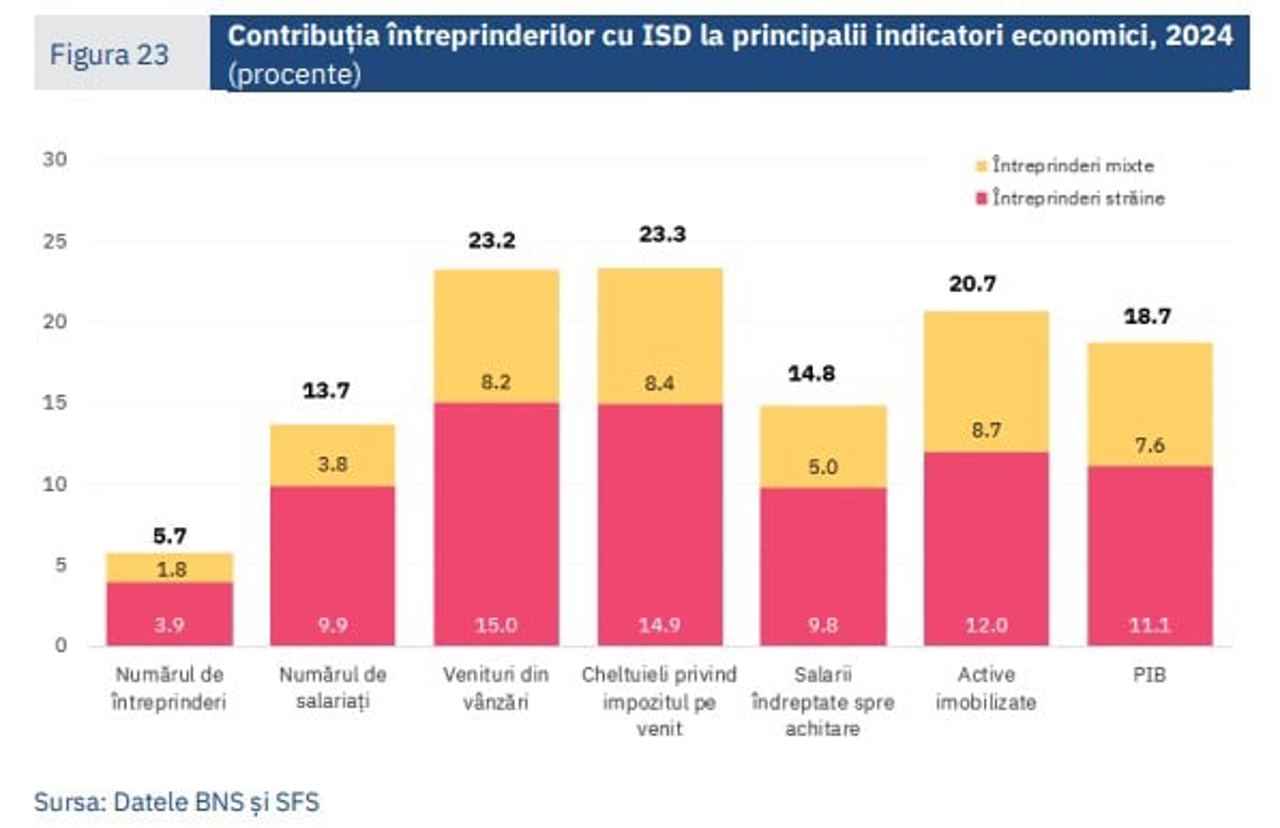
According to the same study, although foreign-owned companies represent only 5.7% of the total number of enterprises in Moldova, their contribution to macroeconomic indicators is disproportionately high:
-
Employment: They account for 13.7% of total employees in the economy.
-
Revenue: They generate 23.2% of national turnover.
-
Fiscal contribution: They support the public budget by paying over 23% of corporate income tax and 14% of social contributions.
Beyond fiscal numbers, the social impact is directly felt in employees’ pockets. Foreign-owned companies remain undisputed leaders in job quality.
“Labor productivity in FDI enterprises is approximately 74% higher than in local private firms, and the average monthly salary offered is about 93% higher,” the study concludes.
Challenges and the need for new capital
Although the stock of foreign direct investment per capita ($2,277 in 2024) still places Moldova in the lower ranks regionally, the evolution over the last decade is impressive: investment volumes have doubled since 2015. At the same time, a share of 30.1% of GDP reflects a significant investment presence, mainly supported by investors already active in the market.
Despite the success of existing companies, the study’s authors warn of stagnation in attracting “new capital” (greenfield investments).
For the Republic of Moldova to make the leap toward a high value-added economy, experts recommend implementing a coherent package of public policies, including measures such as:
-
Increasing business environment predictability
-
Modernizing critical infrastructure
-
Supporting technology projects in IT&C and energy
-
Reducing perceived risks through structural reforms
It should be noted that global foreign direct investment fell by 11% in 2024, marking the second consecutive year of decline and confirming a deep slowdown in productive capital flows. In developed economies, the drop was severe (-22%), including a -58% collapse in Europe. Although developing economies appear broadly stable, the structural reality is fragile: a large portion of capital is concentrated in a few countries, while many economies are bypassed by the investments needed for infrastructure, energy, technology, and job-creating industries.
According to the “Study 4.0: The Impact of Foreign Direct Investment (FDI) on the Economy of the Republic of Moldova”, the investment landscape in 2024 was strongly influenced by geopolitical tensions, trade fragmentation, and increasingly competitive industrial policies. These developments increase volatility and erode long-term investor confidence, prompting multinational companies to prioritize immediate risk management over strategic expansion.